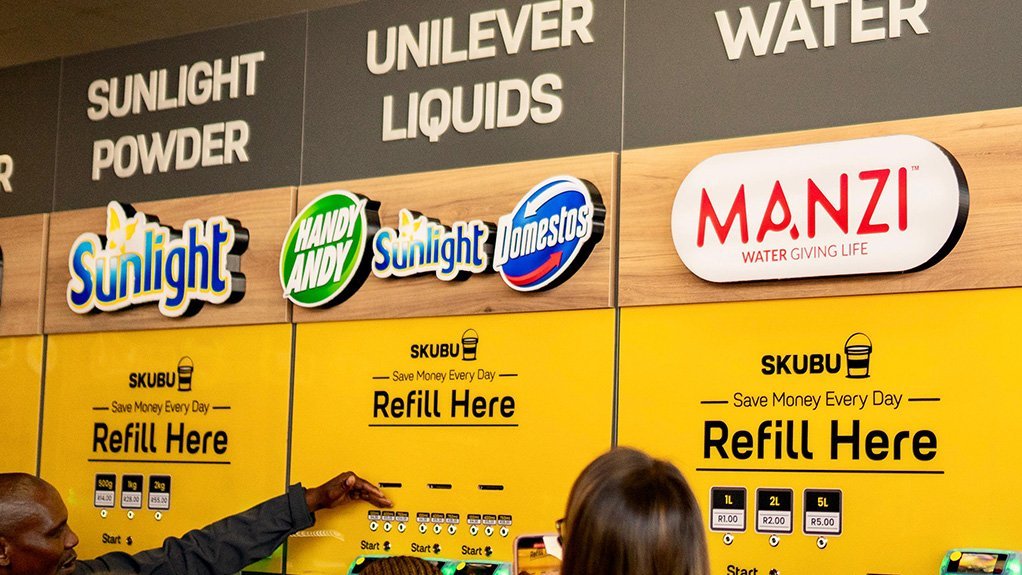
South Africa is testing a new way of buying everyday essentials that could make shopping cheaper while reducing plastic waste.
A first-of-its-kind automated refill store has opened at Chuma Mall in Diepsloot, Gauteng, allowing customers to buy products in the quantities they actually need instead of purchasing traditionally packaged products.
The initiative, known as the SKUBU Project, combines automation, affordable retail and the circular economy in a model designed with underserved communities in mind.
How the Automated Refill Store Works
Unlike a conventional supermarket where products are usually sold in fixed-size bottles, containers or packages, the SKUBU store uses automated refill machines.
Customers can purchase products based on volume, with items priced at fixed rand-per-litre rates. This means shoppers can buy smaller quantities when they do not need a full package.
The approach is designed to tackle two challenges at the same time: the cost of everyday essentials and the amount of single-use packaging entering the waste stream.
According to the project, the model could offer savings of up to 50% compared with conventional retail outlets.
Technology Meets Sustainable Shopping
The store is part of the SKUBU Project, which is being led by Sonke Retail in partnership with the Council for Scientific and Industrial Research (CSIR) and South Africa’s Department of Science, Technology and Innovation.
The project was made possible through the Circular Economy Demonstration Fund and also has support from TRANSFORM, a partnership involving Unilever, the UK’s Foreign, Commonwealth and Development Office, and Ernst & Young.
The idea is straightforward but potentially powerful: use technology to make refill shopping easier, more affordable and easier to scale.
Instead of constantly producing new plastic containers for everyday products, consumers can reuse containers and purchase only the amount they need.
Affordable Drinking Water Included
One of the brands participating in the new store is MANZI Water, which is offering drinking water to residents at R1 per litre.
MANZI Water CEO Alfred Challis said the company was proud to be part of the initiative and viewed the project as an opportunity to improve access to clean and affordable water in the Diepsloot community.
The company’s participation also shows how the refill model can be applied to products that people purchase regularly, particularly basic household necessities.
Why This Matters for Africa
The SKUBU model is interesting beyond South Africa.
Across many African cities, consumers often buy products in small quantities because household budgets can be limited. At the same time, single-use packaging remains a major environmental challenge.
A refill model could potentially address both issues.
For consumers, buying exactly what they need could reduce the amount of money spent on unnecessary packaging or larger quantities. For businesses, refill systems could create new ways of distributing products while reducing packaging requirements.
There is also an opportunity to connect these systems with Africa’s growing digital economy. Automated stores could eventually incorporate digital payments, customer accounts, loyalty systems and data-driven inventory management.
A Model That Could Expand
The SKUBU Project is not being presented simply as a single experimental store. Its partners see potential for the concept to expand to other locations across South Africa.
MANZI Water has said it expects the project to provide a scalable model for sustainable development and create opportunities for licensees within its network.
Whether the concept becomes widely adopted will depend on factors such as consumer acceptance, operating costs, access to suitable products and the ability to maintain automated refill equipment.
But the experiment highlights an important direction for African retail: technology does not always have to mean bigger stores or more expensive shopping experiences. It can also be used to make basic goods more accessible while reducing waste.
The Bigger Picture
South Africa’s automated refill store represents an interesting intersection of retail technology, affordability and sustainability.
For African markets, where consumers are increasingly adopting digital services but affordability remains a major consideration, solutions that combine convenience with lower costs could have significant potential.
If the SKUBU model proves successful in Diepsloot, similar refill stores could eventually appear in other communities — offering consumers a different way to buy everyday essentials while helping reduce dependence on single-use packaging.
The key takeaway: Africa’s retail future may not only be about supermarkets becoming more digital. It could also be about fundamentally changing how products are packaged, priced and delivered to consumers.